Best Airlock for Fermenting Vegetables
The best fermentation airlock for mason jars: waterless silicone valves vs water-lock airlocks vs screw-on lids, which to buy, and how they prevent mold.
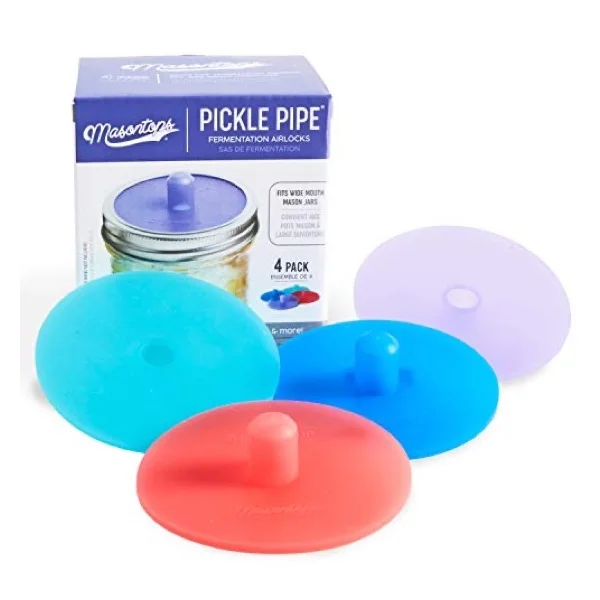
At a glance
| Product | Score | Airlock Performance | Weights & Kit | Fit & Durability | Owner Satisfaction | Value | Buy |
|---|---|---|---|---|---|---|---|
| Masontops Pickle Pebbles + Pipes Kit (8 Piece) Masontops · mid-range | 91 | 100 | 96 | 100 | 85 | 78 | Buy → |
| Masontops Pickle Pipes Airlock Lids (4-Pack) Masontops · value | 88 | 100 | 81 | 100 | 88 | 73 | Buy → |
| Easy Fermenter Waterless Airlock Lids (Wide Mouth, 4-Pack) Easy Fermenter · mid-range | 78 | 77 | 74 | 77 | 81 | 77 | Buy → |
What an airlock actually does
Fermenting vegetables produces carbon dioxide. That gas has to escape, or the jar builds pressure; but if you simply leave the jar open, oxygen and airborne yeasts settle on the surface. An airlock solves both at once: it is a one-way valve that lets carbon dioxide out while keeping air from getting in.
That is why a covered, airlocked ferment is more reliable than an open jar you burp by hand. It removes the most common beginner failure, a film of kahm yeast or mold on the surface.
Three styles, compared
| Style | How it works | Best for |
|---|---|---|
| Waterless silicone valve | Flexes to vent gas | Simplicity, most jars |
| Water-lock airlock | Gas bubbles through water | Traditional setups |
| All-in-one valve lid | Screw lid with built-in valve | Convenience, dating |
Waterless silicone valves such as the Masontops Pickle Pipes seat on a standard wide-mouth jar and need nothing topped up. All-in-one lids like the Easy Fermenter set add a date dial and a firm seal. The Masontops pebbles-and-pipes set pairs valves with weights in one box.
The pick for most people
Start with waterless silicone valves. They are inexpensive, fit the mason jars you likely already own, and there is no water moat to refill or spill. Step up to all-in-one lids if you want the extra conveniences.
The rule the airlock cannot replace
An airlock limits surface air, but it does not hold your vegetables down. Keep everything under the brine with a weight, at the right salt level, and you remove the conditions mold needs. See how much salt for fermenting and glass versus ceramic weights. For food-safety questions, defer to USDA, the NCHFP and your local extension service, not a rule of thumb.
Waterless silicone valves like the Masontops Pickle Pipes are the simplest reliable airlock for mason-jar ferments. All-in-one valve lids are just as good and add conveniences. None of them replace the real rule: keep the vegetables submerged under the brine with a weight.
Frequently asked questions
Do you really need an airlock to ferment vegetables?
No, but it makes success far more reliable. An open jar burped by hand can work, yet it exposes the surface to air, which is where kahm yeast and mold take hold. A one-way airlock vents carbon dioxide while keeping oxygen out, so it lowers the main risk with almost no effort.
Are waterless valves or water-lock airlocks better?
For most home fermenters, waterless silicone valves are simpler: nothing to refill or spill, and they seat on standard mason jars. Traditional water-lock airlocks work equally well but need their moat topped up. The choice is convenience, not results.
What actually prevents mold on a ferment?
Keeping the vegetables fully under the brine, at the right salt level, is what prevents mold; the airlock only helps by limiting surface air. Use a weight to hold everything down. For food-safety questions, follow USDA, the NCHFP and your local extension service rather than a rule of thumb.
Some links are affiliate links: if you buy through them we may earn a commission at no extra cost to you. It never changes our rankings. Full disclosure.