How Many Oxygen Absorbers Do I Need?
How many oxygen absorbers you need by container size, from a quart jar to a 5-gallon bucket, which cc rating to buy, and how many per bag.
At a glance
| Product | Score | Absorption & Reliability | Sizing Options | Value & Freshness | Owner Satisfaction | Value | Buy |
|---|---|---|---|---|---|---|---|
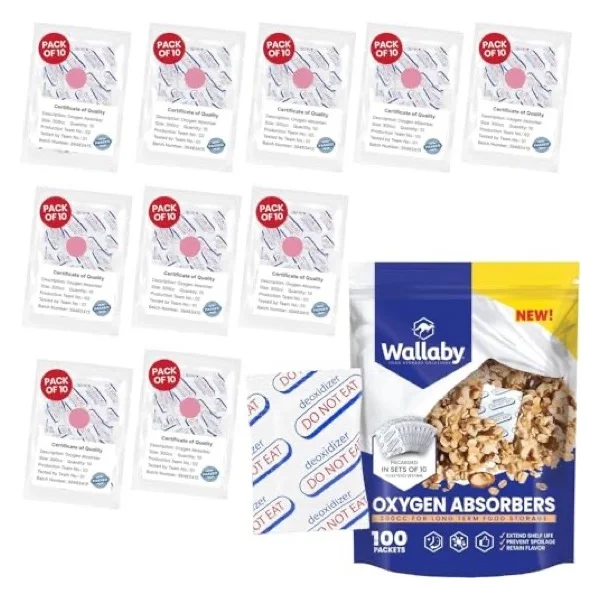
| Wallaby 300cc Oxygen Absorbers (100 Count) Wallaby · premium | 87 | 100 | 87 | 99 | 88 | 65 | Buy → |
| Wallaby 2000cc Oxygen Absorbers (20 Count) Wallaby · premium | 87 | 99 | 93 | 93 | 88 | 65 | Buy → |
| O2frepak 300cc Oxygen Absorbers (50 Pack) O2frepak · value | 85 | 100 | 85 | 88 | 80 | 72 | Buy → |
Size the absorber to the air, not the food
Oxygen absorbers are rated in cubic centimetres, or cc, which measures how much oxygen they can consume. The number you need depends on the air trapped in the container, both the headspace and the gaps between and inside the food, not the weight of the food itself.
Dense staples like rice, wheat and beans pack tightly and hold less air, but you still size for the whole container to stay safe.
The quick sizing table
| Container | Typical absorber |
|---|---|
| Quart jar or bag | 50 to 100cc |
| One-gallon mylar bag | 300cc |
| Two-gallon mylar bag | 500 to 600cc |
| 5-gallon bucket with mylar | 2000cc, or 5 to 7 x 300cc |
These are the widely used food-storage figures from absorber makers and university-extension guidance. They are deliberately generous, because the cost of rounding up is nothing and the cost of rounding down is oxygen left behind.
Which to buy
- 300cc is the everyday workhorse: right for jars and one-gallon bags, and you combine them for bigger containers.
- 2000cc is the single-absorber answer for a 5-gallon bucket.
The Wallaby 300cc and 2000cc packs are our picks for reliability; the O2frepak 300cc is the budget option when you need a lot at once.
Two rules that matter more than brand
Keep spare absorbers in an airtight jar the moment the pack is opened, because they begin working within minutes of air exposure. And never put them in sugar or salt: there is no spoilage oxygen to remove, and the absorber makes these cake into a brick. For anything you are unsure is still safe to eat, follow USDA and NCHFP guidance rather than a calendar.
Match the absorber to the headspace: roughly 50 to 100cc per quart, 300cc per one-gallon bag, and 2000cc per 5-gallon bucket. Rounding up is safe; rounding down leaves oxygen behind. Buy 300cc for everyday jars and gallon bags, and 2000cc for buckets.
Frequently asked questions
What size oxygen absorber for a 5-gallon bucket?
About 2000cc for a 5-gallon bucket lined with a mylar bag, or five to seven 300cc absorbers if that is what you have. The figure covers the air trapped between and inside dense staples like rice or wheat. Rounding up is fine; too little leaves oxygen behind.
Can you use too many oxygen absorbers?
No, not in a way that harms the food. Excess capacity simply sits unused, so erring high is the safe direction. The real failure is using too few, which leaves oxygen that lets fats go rancid and pantry pests survive. Do not use oxygen absorbers in sugar or salt, which cake around them.
How do I know if an oxygen absorber is still good?
Keep unused absorbers in an airtight jar; a small pack works within minutes of air exposure, so an open bag left out is likely spent. Many come with an indicator, and a good absorber feels warm as it reacts. Our guide on whether oxygen absorbers expire covers storage in detail.
Some links are affiliate links: if you buy through them we may earn a commission at no extra cost to you. It never changes our rankings. Full disclosure.