Chamber vs. External Vacuum Sealer: Which Do You Need?
Chamber sealers handle liquids and cost more; external sealers are cheaper and fine for most homes. How they differ and which is right for you.
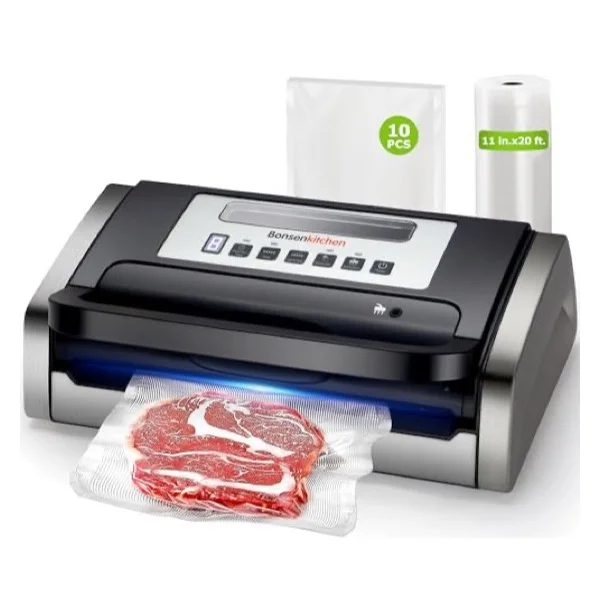
At a glance
| Product | Score | Seal Reliability | Ease & Speed | Versatility | Owner Satisfaction | Value | Buy |
|---|---|---|---|---|---|---|---|
| Bonsenkitchen Vacuum Sealer Machine Bonsenkitchen · mid-range | 84 | 87 | 96 | 93 | 73 | 76 | Buy → |
| FoodSaver FM2100 Vacuum Sealer Machine FoodSaver · mid-range | 81 | 92 | 92 | 83 | 69 | 77 | Buy → |
| MegaWise Vacuum Sealer Machine MegaWise · budget | 72 | 66 | 75 | 75 | 63 | 84 | Buy → |
There are two kinds of vacuum sealer, and they work in completely different ways. Most people only ever need one of them.
How they differ
An external sealer, the common countertop kind, holds the open end of the bag against a sealing bar and sucks the air out through it. A chamber sealer puts the entire bag inside a rigid chamber, removes the air from the whole chamber at once, then seals the bag before letting the air back in.
That mechanical difference drives everything else:
| External sealer | Chamber sealer | |
|---|---|---|
| Price | Low, often under 100 dollars | High, often 400 dollars and up |
| Size | Compact countertop | Large and heavy |
| Liquids and soups | Awkward; must freeze first | Seals liquids easily |
| Bag cost | Textured bags, pricier | Flat bags, much cheaper |
| Best for | Everyday home use | Liquids, high volume, small business |
Why external wins for most homes
For sealing meat, cheese, dry goods and leftovers, an external sealer does the same core job for a fraction of the price and shelf space. The textured bags cost more per bag, but a normal household seals few enough that it never adds up to the price gap. This is why our ranked picks are all external machines.
The one real weakness is liquids: an external sealer will suck soup right up into the machine. The workaround is simple, freeze liquids solid first, which our liquids guide walks through.
When a chamber sealer earns its price
Chamber machines make sense if you:
- Seal soups, stews, marinades or brines regularly and don't want to pre-freeze.
- Seal in high volume every week, where the cheaper flat bags actually add up.
- Run a small food business or do a lot of sous vide.
For that user, the lower bag cost and true liquid handling repay the size and price. For everyone else, an external sealer is the honest answer, and the three below are where we'd start.
For nearly every home, an external sealer is the right call: cheaper, smaller and perfectly good for meat, cheese and dry goods. Consider a chamber sealer only if you seal soups and marinades often or run big weekly batches, where cheaper bags and true liquid sealing repay the size and price.
Frequently asked questions
Do I need a chamber vacuum sealer?
For nearly every home kitchen, no. An external suction sealer is cheaper, smaller and perfectly good for meat, cheese and dry goods. A chamber sealer earns its price only if you frequently seal liquids and soups or work at high volume.
Can an external vacuum sealer handle liquids?
With care. Marinades and soups can be pulled toward the seal, so use the moist setting, chill or briefly freeze the bag first, or leave extra headspace. If you seal liquids often, a chamber sealer handles them cleanly.
Why are chamber sealers so much more expensive?
They enclose the whole bag in a vacuum chamber, which needs a stronger pump and a heavier build, raising the price and size. The payoff is clean liquid sealing and faster repeat cycles, which mainly matter for frequent or commercial use.
Some links are affiliate links: if you buy through them we may earn a commission at no extra cost to you. It never changes our rankings. Full disclosure.