Best Oxygen Absorbers for Long-Term Food Storage
The best oxygen absorbers for long-term food storage, ranked by real cost per packet, with the indicator and resealable features worth paying for.
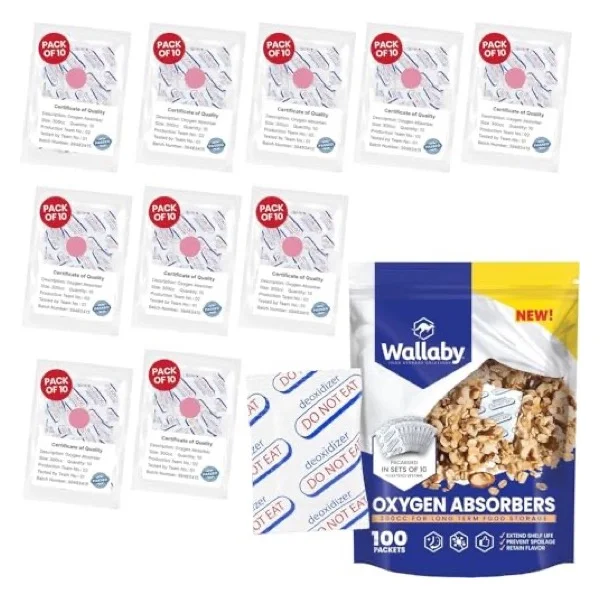
At a glance
| Product | Score | Absorption & Reliability | Sizing Options | Value & Freshness | Owner Satisfaction | Value | Buy |
|---|---|---|---|---|---|---|---|
| Wallaby 300cc Oxygen Absorbers (100 Count) Wallaby · premium | 87 | 100 | 87 | 99 | 88 | 65 | Buy → |
| O2frepak 300cc Oxygen Absorbers (50 Pack) O2frepak · value | 85 | 100 | 85 | 88 | 80 | 72 | Buy → |
| OxySorb 300cc Oxygen Absorbers (100 Pack) OxySorb · budget | 82 | 98 | 83 | 75 | 70 | 87 | Buy → |
An oxygen absorber is the cheapest part of long-term storage and the one that does the actual preserving, taking rice, beans and wheat from a year on the shelf to decades. The six we rank all do that core job. What separates them is the cost per packet, whether they tell you they are still working, and whether the leftovers survive in the drawer. Here is the whole field, priced out.
The field, by cost per absorber
Every absorber here is 300cc unless noted, sized for a 1 to 2 gallon bag. The number that decides a big project is cost per packet, so we worked it out from the pack price and count:
| Absorber | Size | Count | Price | Cost each | Indicator | Resealable | Best for |
|---|---|---|---|---|---|---|---|
| OxySorb | 300cc | 100 | $9.99 | $0.10 | No | No | Cheapest, one-session fills |
| FreshUS | 300cc | 100 (10 strips) | $11.99 | $0.12 | No | Strips | Bulk, open a strip at a time |
| O2frepak | 300cc | 50 | $13.99 | $0.28 | Yes | Yes | Value with an indicator |
| PackFreshUSA | 300cc | 100 | $24.99 | $0.25 | Yes | Yes | US supplier, indicator |
| Wallaby (top pick) | 300cc | 100 | $27.99 | $0.28 | Yes | Yes | Best all-round |
| Wallaby 2000cc | 2000cc | 20 | $22.99 | $1.15 | No | Yes | 5-gallon buckets |
The spread is real: the cheapest packet costs about a dime, the top pick about 28 cents. That extra 18 cents buys an oxygen indicator dot and a resealable pouch, and across a 40-bag project it adds up to only about seven dollars total. For bucket-scale storage the 2000cc Wallaby is the value play, because one packet does a whole 5-gallon bag and works out cheaper per unit of capacity than stacking small ones.
What the extra cents actually buy
They all scavenge oxygen down to a fraction of a percent. Three things separate the good ones, and they are what the cost-each gap pays for:
- An oxygen indicator dot that changes colour so you can confirm a packet is still active before you seal food away for a decade.
- Fresh, resealable packaging so the packets you do not use in one session do not spoil in the drawer. A spoiled bag of loose, exhausted absorbers is the most common way people waste money here.
- A known, food-grade source with a track record in the long-term storage community.
Buy fresh, use fast. Absorbers start working the moment they meet air. Buy individually sealed or stripped packs, open only what you will use in one session, and reseal the rest right away. Exposed absorbers are spent within about half an hour.
The picks
- Best all-round: Wallaby 300cc ($27.99). Indicator dot, resealable vacuum pouch, and a big following. It costs a little more per packet, and the confidence is worth it.
- Best value: O2frepak 300cc ($13.99). Keeps the indicator at a lower price and seals well for oily foods like jerky and nuts.
- Cheapest to fill many bags: OxySorb 300cc ($9.99). A dime a packet, no indicator, basic packaging, so open the pack only when you are ready to seal everything.
- For 5-gallon buckets: Wallaby 2000cc ($22.99). One packet per bucket beats stacking small ones, and it is cheaper per unit of capacity.
How many cc do you need?
The rule of thumb is roughly 300 to 500cc per gallon of dry food, so one 300cc packet suits a 1 to 2 gallon bag and a single 2000cc packet suits a 5-gallon bag. The full math by container size is in how many oxygen absorbers do I need, and the absorber calculator sizes it for your exact container.
What they protect, and what they do not
Oxygen absorbers only protect genuinely dry, shelf-stable foods: rice, beans, wheat, oats, flour, pasta, powdered milk. They do not make moist or oily foods safe, and low oxygen around moist food can favour botulism, so route anything perishable to refrigeration or freezing. They also fuse sugar and salt into a brick, so store those dry with no absorber. For what is safe to store long term, follow USDA and the National Center for Home Food Preservation.
Sources and method
Cost-each is the pack price divided by the packet count, from our current tracked prices, which change over time. Indicator and packaging details are from each supplier's stated specifications. Shelf-life claims are quality windows for correctly sealed dry staples, not safety guarantees; follow USDA and NCHFP for food-safety decisions.
The Wallaby 300cc is the best oxygen absorber for most people thanks to its indicator dot and resealable packaging; the O2frepak is the value pick with an indicator, and OxySorb is the cheapest for bulk sealing. Size the cc to your container and always buy fresh, individually sealed packs.
Frequently asked questions
What is the best oxygen absorber for long-term food storage?
The Wallaby 300cc is the best all-round pick, because it adds an oxygen indicator dot and a resealable pouch for about 28 cents a packet. If you want the indicator for less, the O2frepak is the value choice; to fill many bags cheaply, OxySorb is about a dime a packet with no indicator.
How much do oxygen absorbers cost per packet?
For 300cc absorbers, roughly 10 cents each at the cheap end (OxySorb) up to about 28 cents for the top pick with an indicator and resealable packaging (Wallaby). The premium is small in absolute terms: on a 40-bag project the difference is around seven dollars.
How many oxygen absorbers do I need per gallon?
Roughly 300 to 500cc per gallon of dry food, so a single 300cc packet suits a 1 to 2 gallon bag and a 2000cc packet suits a 5-gallon bag. Step up the capacity rather than stacking many small packets in a big container.
Do oxygen absorbers work for sugar, salt, or moist foods?
No. They fuse sugar and salt into a solid brick, and they do not make moist or oily foods safe to store, where low oxygen can even favour botulism. Use them only for genuinely dry, shelf-stable staples, and follow USDA and NCHFP for perishables.
Some links are affiliate links: if you buy through them we may earn a commission at no extra cost to you. It never changes our rankings. Full disclosure.